GENX Parametric Innovation Framework for Compostable Bottle Design
A scalable and interdisciplinary research innovation platform for circular product development
Rethinking Packaging for a Circular Future
The environmental impact of plastic packaging has become one of the most pressing global challenges. As production continues to rise, packaging remains the largest contributor to plastic waste, placing increasing pressure on ecosystems and waste management systems. While biodegradable polymers such as PLA and PHAs offer promising alternatives, their large-scale adoption is still limited by technical constraints related to performance, manufacturability, and controlled degradation.
At the same time, designing truly sustainable products requires more than material substitution. It demands a systemic approach that integrates material science, product design, manufacturing processes, and environmental impact from the earliest stages. Without such integration, sustainability remains an afterthought rather than a design driver. Bridging this gap is essential to accelerate the transition toward a circular economy.
A New Framework for Circular Product Innovation
Developed at the Georgia Institute of Technology’s Industry Innovation | Circular Economy (I2CE) Lab led by Dr. Ingeborg Rocker, the GENX Parametric Innovation Framework brings together research and education within a unified, interdisciplinary platform. The project combines expertise in engineering, materials science, architecture, and computational design to create a new model for sustainable product development, where environmental performance is evaluated alongside technical feasibility from the very beginning.
The project began with a simple but urgent question, raised through discussions between the I2CE Lab and representatives from the Family Islands in the Bahamas: can a fully compostable water bottle be designed that does not pollute fragile island and water ecosystems and instead contributes to restoring environmental value in these systems. Within the GENX framework, more than 100 students across disciplines worked collaboratively to design biodegradable bottle systems by integrating materials science, parametric design, manufacturing constraints, and lifecycle assessment into a unified, systems-level workflow. This was not a classroom exercise. They were immersed in a real-world “wicked problem,” where technical performance, environmental impact, and societal context are inseparable.
At its core, the GENX Parametric Innovation Framework aims to enable data-driven circular design. It integrates biodegradable material research, parametric product modeling, manufacturing analysis, and cradle-to-cradle lifecycle assessment into a single digital workflow. This approach allows designers and engineers to explore multiple design scenarios, optimize product performance, and assess environmental impact in real time. At the same time, the project serves as an educational platform, training students to tackle complex sustainability challenges through hands-on, research-based learning. GENX is shaping a new generation of engineers capable of designing solutions that are not only technically robust, but also socially responsive and environmentally restorative, moving from minimizing harm toward actively contributing to resilient, circular ecosystems.
Designing the Future with Virtual Twins
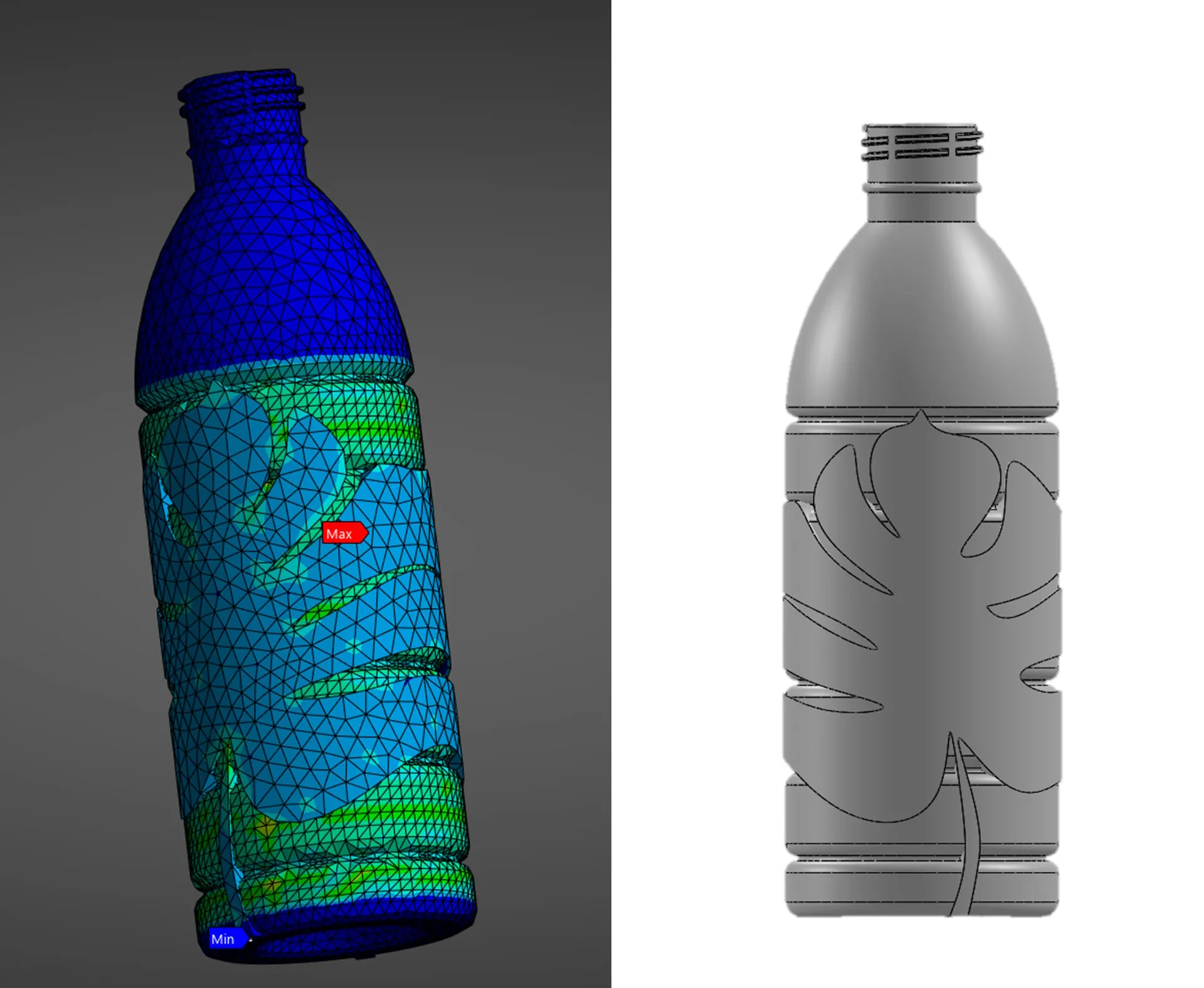
With the support of La Fondation Dassault Systèmes in the US, the GENX innovation framework leverages advanced digital engineering tools, including virtual twin technologies, to transform how sustainable products are conceived and developed. By creating a digital thread that connects material properties, geometry, manufacturing constraints, and environmental metrics, the project enables a fully integrated and iterative design process.
This approach will lead to the development of a new generation of compostable bottle solutions based on a PLA–alginate–enzyme biocompound, engineered to meet food-grade and manufacturing standards while enabling accelerated decomposition with a targeted performance of under 14 days under optimized composting conditions, achieved through controlled enzymatic activity. Through parametric modeling and simulation, the team can test how variations in material composition and design parameters influence structural performance, manufacturability, and degradation behavior. This combination of material innovation and 3D simulation represents a major step forward in scalable circular design.
From Research to Real-World Impact
By bridging research and education, this project is creating tangible impact across multiple dimensions. Students are immersed in a cutting-edge learning environment where they gain hands-on experience in circular design, lifecycle assessment, and digital manufacturing. This experiential approach equips the next generation of engineers and designers with the skills needed to address complex environmental challenges.
At the same time, the project advances scientific and technological innovation by exploring new biodegradable material systems and their applications. The development of compostable packaging solutions capable of meeting industry standards while significantly reducing environmental impact demonstrates the potential of this integrated approach. Beyond academia, the framework is designed to engage community organizations and industry partners, ensuring that solutions are grounded in real-world conditions and can be adopted at scale.
Building Momentum: Achievements and Next Steps
At its current stage, the GENX project has established a fully operational research framework integrating biodegradable material screening, parametric bottle design, manufacturing analysis, and lifecycle assessment within a model-based systems architecture. Early results include the development of parametric design tools, the identification of promising biodegradable polymer families, and initial lifecycle models demonstrating significant reductions in environmental impact compared to conventional materials.
The next phase will focus on prototyping, experimental validation, and deeper integration with advanced digital platforms. Physical bottle prototypes will be produced and tested, while the virtual twin environment will be further refined to simulate real-world conditions with greater accuracy. Ultimately, the project aims to deliver an open, scalable toolkit that can be adopted globally, empowering educators, researchers, and manufacturers to accelerate the transition toward regenerative and circular product systems.
The 2030 Agenda for Sustainable Development
Adopted by all United Nations member states, the 2030 Agenda for Sustainable Development provides a shared blueprint for peace and prosperity for people and the planet, now and into the future. At its heart are the 17 Sustainable Development Goals (SDGs), which are an urgent call for action by all countries - developed and developing - in a global partnership. La Fondation Dassault Systèmes supports the GENX Parametric Innovation Framework for Compostable Bottle Design project in meeting eight of these goals: Quality Education, Decent Work and Economic Growth, Industry, Innovation and Infrastructure, Sustainable Cities and Communities, Responsible Consumption and Production, Climate Action, Life Below Water, and Partnerships for the Goals.


About our Partner
Georgia Institute of Technology I2CE Lab
The Industry Innovation | Circular Economy (I2CE) Lab is a transdisciplinary research laboratory at Georgia Tech. The lab works closely with academic, industry, and community partners to advance integrative innovation for a circular economy. Following the Lab’s Industry Innovation Framework, sustainable solutions are developed by leveraging emerging technologies. From vision to realization, the I2CE Lab works on socially, environmentally, and economically sustainable projects to protect and steward natural resources while sustainably benefiting local populations’ livelihoods. It integrates applied and computational research across bio-based and compostable materials, algae-derived green cosmetic formulations, parametric design engines for rapid product development, and biomedical devices.
The Lab actively engages with communities most affected by climate change, including impacts such as rising temperatures, flooding, ocean warming, and ecosystem loss. Central to the process is deep collaboration between local communities and the Georgia Tech ecosystem, fostering meaningful connections that bridge academic research with measurable, on-the-ground impact.